
Why You're Not Becoming Flexible
by Hardik Mehta
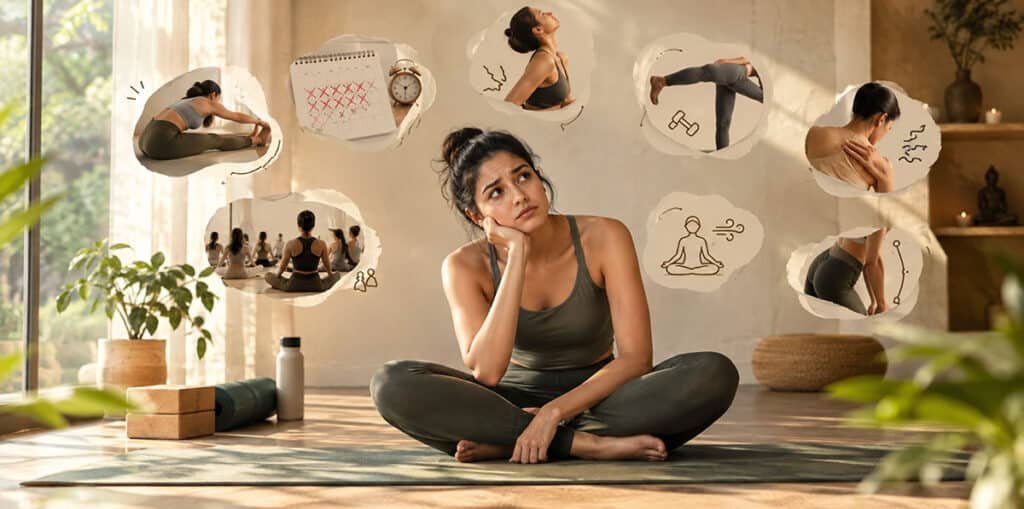
Flexibility is one of the most visible changes people hope to experience when they begin yoga. You may imagine yourself moving effortlessly into a forward fold, sitting comfortably in Padmasana, reaching deeper into a hip-opening posture, or eventually touching your toes without bending your knees.
But what happens when you practise regularly and still feel stiff?
You stretch. You attend yoga classes. You try different yoga poses for flexibility. Yet your body seems to be saying, “Not today.”
The problem may not be that you are incapable of becoming flexible. More often, it is the way flexibility is approached.
Flexibility develops through consistent, intelligent practice rather than simply pushing yourself further into a stretch. Research also supports the effectiveness of regular stretching for improving range of motion, while yoga has been shown to improve flexibility and mobility when practised consistently.
So, why are you not becoming flexible? Let’s explore some of the most common reasons.
1. You’re Expecting Results Too Quickly
One of the biggest mistakes is expecting flexibility to improve within a few days or weeks.
Your body has its own timeline. If your muscles, joints and nervous system have adapted to years of limited movement, they are unlikely to transform overnight.
Flexibility is a gradual process. Your range of motion can improve with regular stretching, but meaningful changes require patience and repetition. Studies examining long-term stretching have found that consistent stretch training can increase joint range of motion.
Instead of asking:
“How quickly can I become flexible?”
Ask:
“How consistently can I practise?”
That shift in mindset can make your yoga journey much more sustainable.
2. You’re Stretching Only When You Remember
Doing a long flexibility session once every two weeks is unlikely to create the same effect as maintaining a manageable routine throughout the week.
Consistency matters because your body needs repeated exposure to movement.
This doesn’t necessarily mean spending an hour stretching every day. Even a shorter, well-planned practice can be useful when it becomes part of your routine.
You could include:
- Gentle hip mobility in the morning
- A few hamstring stretches after movement
- Shoulder-opening movements during breaks
- Yoga asanas that gradually explore your range of motion
- A short evening mobility sequence
The goal is not to stretch more simply for the sake of stretching. The goal is to practise intelligently and consistently.
3. You’re Forcing the Stretch
This is one of the most important lessons in yoga.
A deeper stretch is not automatically a better stretch.
If you repeatedly push your body until you feel sharp pain, intense discomfort or strain, you may be treating flexibility like a competition rather than a practice.
Yoga encourages awareness. You should be able to observe sensations without aggressively fighting your body’s boundaries.
A useful distinction is:
Challenge ≠ pain.
You can experience a gentle pulling sensation or muscular effort without forcing yourself into an uncomfortable position.
If a posture feels painful, unstable or unsafe, back off and consider modifying it or seeking guidance from a qualified yoga teacher.
4. You’re Ignoring Strength
Flexibility and strength are not opposites.
In fact, developing strength can help you control the range of motion you already have.
Imagine being able to passively move your leg higher but not being able to control that position. That is very different from having strength and stability throughout the same range.
A balanced yoga practice therefore shouldn’t focus only on stretching.
Include movements that develop:
- Core strength
- Hip stability
- Leg strength
- Shoulder stability
- Controlled joint movement
This creates a stronger foundation for your yoga flexibility journey.
5. You’re Not Warming Up Properly
Trying to force a deep stretch when your body is cold can make the practice feel unnecessarily difficult.
A gradual warm-up helps prepare your body for movement. Instead of immediately attempting your deepest forward fold or hip opener, begin with gentle movement.
For example, you might start with:
Joint movements → gentle dynamic movements → Sun Salutations → standing postures → deeper stretches
This progression allows the body to move gradually rather than being asked to suddenly access a larger range of motion.
6. You’re Focusing on One Tight Area Without Looking at the Whole Body
Sometimes the area that feels tight isn’t the only factor limiting your movement.
For example, difficulty in a forward fold may involve more than simply “tight hamstrings.” Pelvic movement, hip mobility, spinal movement, strength and individual anatomy can all influence how the posture looks and feels.
Similarly, difficulty in certain hip-opening postures may not be solved simply by doing more hip stretches.
This is why understanding yoga anatomy and flexibility is so valuable.
Rather than asking, “Which muscle should I stretch?”, a more useful question can be:
“What is actually limiting this movement?”
That is a much more informed way to approach asana practice.
7. You’re Comparing Your Body With Someone Else’s
This is particularly common in yoga classes.
You look across the room and see someone effortlessly folding forward while your fingertips barely reach your shins.
It can be tempting to think:
“They practise better than me.”
But flexibility is influenced by many individual factors, including anatomy, previous activity, training history and the structure of your body.
Two people can perform the same asana differently and both be practising appropriately.
Yoga isn’t about creating identical shapes with every body.
It is about developing awareness, control and an appropriate relationship with your own body.
8. You’re Confusing Flexibility With Mobility
Although the terms are often used together, flexibility and mobility aren’t exactly the same.
Flexibility generally refers to the ability of tissues to lengthen and allow a joint to move through a range.
Mobility involves how well you can actively and controllably move through that range.
This distinction matters.
You may have enough passive flexibility to reach a certain position but lack the strength or control to move into it comfortably.
That is why an effective yoga practice should not consist entirely of passive stretching. Combining mobility, strength, stability, breath and mindful movement can create a more complete approach.
9. Your Breathing Is Working Against You
Have you ever noticed yourself holding your breath when a posture becomes difficult?
It is a common reaction.
But breath is an important part of yoga practice. Holding the breath can increase unnecessary tension and make it harder to remain relaxed and aware.
Instead, try maintaining slow, steady breathing while staying within an appropriate range.
Rather than using the breath to force yourself deeper, use it to remain present.
The objective isn’t:
“Exhale so I can push further.”
It is:
“Exhale so I can soften unnecessary tension and observe.”
That subtle difference can completely change how you experience a posture.
10. You’re Doing the Same Stretches Without Progression
Repeating the same sequence forever may eventually stop challenging your body in a meaningful way.
Once a movement becomes comfortable, you can gradually explore progression through:
- Longer holds
- Controlled repetitions
- Different variations
- Props
- Active mobility
- Strength work
- More appropriate sequencing
Progression doesn’t mean immediately attempting an advanced posture.
It means making your practice appropriately more challenging as your capacity develops.
Recent research has found that static stretching can meaningfully improve flexibility, while also suggesting that more stretching is not automatically better.
This reinforces an important principle:
More is not always better. Better is better.
11. You’re Not Giving Your Body Enough Recovery
More yoga isn’t necessarily better yoga.
If you constantly push into intense stretching without allowing adequate recovery, your practice may start feeling exhausting rather than productive.
Your body needs time to adapt.
A balanced routine might include a combination of:
- Active yoga
- Gentle mobility
- Strength-building
- Restorative practice
- Rest days
Pay attention to how your body feels rather than blindly following a fixed idea of what your practice should look like.
How to Improve Your Flexibility in Yoga
If you feel stuck, return to the basics.
Start with a realistic routine
Practise regularly rather than occasionally pushing yourself through an exhausting flexibility session.
Warm up first
Prepare your body with gentle movements before deeper stretches.
Work on mobility and strength
Don’t make passive stretching the entire focus of your practice.
Use props
Blocks, straps, bolsters and blankets can make postures more accessible while helping you maintain better alignment.
Respect your anatomy
Not every body will look the same in the same asana—and that is completely normal.
Be patient
Flexibility is not a final destination. Your body will continue to change with practice, age, activity and experience.
Flexibility Is More Than Touching Your Toes
It is easy to measure progress by asking whether your hands have reached the floor.
But flexibility in yoga is about much more than a visual shape.
Can you move with greater ease?
Can you maintain control?
Can you breathe comfortably?
Can you enter and exit postures with awareness?
Can you move without constantly fighting your body?
These are equally valuable signs of progress.
Yoga research has also demonstrated improvements in flexibility, balance, strength and mobility through regular practice, reinforcing that yoga can be much more comprehensive than simply “stretching.”
The real goal isn’t to become the most flexible person in the room.
It is to develop a body that moves with greater freedom, stability and awareness.
Learn the “Why” Behind Your Practice With Sayujya Yoga
Understanding why you’re struggling with flexibility is just as important as knowing which yoga poses for flexibility to practise.
This is where structured yoga education becomes valuable.
Sayujya Yoga, one of the best Yoga Institute in Mumbai, is a Yoga Alliance-affiliated yoga school based in Mumbai that offers structured Yoga Teacher Training Courses, including 200-hour and 300-hour programs, along with continuing education courses.
Its Advanced Holistic YTTC goes beyond simply practising asanas. The curriculum incorporates areas such as anatomy, physiology, pranayama, meditation, philosophy, teaching methodology, sequencing and therapeutic applications of yoga.
That broader understanding is particularly relevant when exploring flexibility.
Sayujya Yoga’s continuing education offerings also include Sthira Sukham Asanam – Asana Alignment Specialist, which covers musculoskeletal anatomy, muscle tension, joint compression, joint and muscle assessments, asana mechanisms, prop work and anatomy-based sequencing.
For aspiring teachers and serious practitioners, this kind of education can help transform the question from “How do I stretch further?” to “How do I understand movement better?”
And that is ultimately the deeper lesson behind flexibility.
Final Thoughts
If you’re not becoming flexible, don’t immediately assume that your body is the problem.
Perhaps you’re rushing.
Perhaps you’re stretching inconsistently.
Perhaps you’re forcing postures.
Perhaps you’re overlooking strength, mobility, anatomy or recovery.
Or perhaps you’re simply expecting your body to change faster than it naturally can.
Flexibility is built through patience, consistency, awareness and intelligent progression.
Instead of chasing the deepest version of a posture, learn to understand your body. Instead of comparing your shape with someone else’s, observe your own progress.
Your flexibility journey doesn’t need to be rushed.
It needs to be understood.
About the Author
Hardik Mehta
Hardik is an E-RYT 500 & YACEP (Yoga Alliance Continuing Education Provider), Yoga Alliance, USA. He has been practicing yoga for the last 9 years. Prior to finding his true calling in Yoga, he was working with various corporates for 12 years in the Retail and eCommerce sector.