

Yoga is often associated with flexibility, physical strength, meditation, and breathwork. But at its deepest level, yoga is also about how we live, think, respond, and connect with a higher purpose. Few figures in Indian tradition embody these dimensions as powerfully as Hanuman.
Known for his immense strength, unwavering devotion, courage, humility, and disciplined mind, Hanuman offers several meaningful lessons for anyone walking the yogic path. His story is not simply about physical power or extraordinary abilities. It is about discovering one’s inner potential and using it with awareness, purpose, and selflessness.
These teachings are especially relevant for students exploring yoga philosophy in an Advanced Yoga Teacher Training Course (Advanced YTTC), where yoga goes beyond performing postures and becomes a study of the body, breath, mind, philosophy, and the way these dimensions come together.
Who Is Hanuman in the Yogic Tradition?
Hanuman is one of the most revered figures in the Ramayana and is traditionally associated with qualities such as courage, devotion, strength, wisdom, and service. He is regarded as a devoted servant of Lord Rama, and his actions are often understood through the lens of Bhakti Yoga, the path of devotion.
His connection with Vayu, the deity associated with wind, also makes Hanuman an interesting symbolic figure when exploring prana and breath. Some yoga traditions interpret Hanuman’s extraordinary vitality and control as symbolic of mastery over one’s energy, senses, and mind.
Rather than viewing Hanuman only as a mythological hero, yoga practitioners can look at his story as a collection of principles that can be applied to everyday life.
Here are some of the most powerful yoga lessons from Hanuman.
1. True Strength Comes with Humility
Hanuman possesses extraordinary physical strength, yet he does not use that strength to prove his superiority.
This is one of the most important lessons for a yoga practitioner.
In yoga, strength is not simply about stronger muscles or achieving advanced asanas. True strength can also mean the ability to remain steady when circumstances are difficult, control one’s reactions, and use one’s abilities responsibly.
Hanuman’s humility reminds us that strength without awareness can become ego, while strength guided by humility becomes service.
This is particularly relevant for advanced practitioners. As we become stronger, more flexible, or more experienced, yoga asks us to become more grounded—not more arrogant.
The goal is not to impress others with an advanced pose. The goal is to understand ourselves better through the practice.
2. Devotion Gives Practice a Deeper Purpose
One of the most recognizable qualities of Hanuman is his unwavering devotion to Rama.
This connects closely with Bhakti Yoga, where devotion and surrender become pathways toward spiritual growth. Hanuman’s story demonstrates how dedication to something greater than the individual ego can transform effort into meaningful practice.
This idea can completely change the way we approach yoga.
Instead of asking:
“How far can I go in this posture?”
we can ask:
“What can this practice teach me?”
Instead of practising only for appearance, flexibility, or physical achievement, we can practise with gratitude, awareness, and sincerity.
Yoga becomes less about performance and more about connection.
3. Discipline Creates Inner Power
Hanuman’s accomplishments are not simply symbols of natural strength. They represent dedication, courage, focus, and commitment to his purpose.
This teaches an important principle of yoga practice: consistency matters more than occasional intensity.
You do not need to practise perfectly every day. But showing up regularly creates transformation.
A disciplined yoga practitioner gradually learns to:
- Maintain a consistent sadhana
- Observe the breath
- Develop concentration
- Study yoga philosophy
- Practise self-awareness
- Work patiently with limitations
This is why the yogic path is often described as a journey rather than a destination.
Hanuman’s example reminds us that extraordinary possibilities can emerge when discipline is combined with purpose.
4. Know Your Inner Potential
One of the most inspiring themes associated with Hanuman is the awakening of his awareness of his own abilities.
The story of Hanuman’s leap across the ocean is often interpreted symbolically: sometimes, the greatest obstacle is not the absence of ability but the belief that we are incapable.
This has a powerful connection to yoga.
Many practitioners begin by thinking:
“I’m not flexible.”
“I can’t meditate.”
“My mind is too restless.”
“I could never become a yoga teacher.”
But yoga teaches us to observe these thoughts rather than automatically accept them as truth.
Through consistent practice, we begin to understand ourselves differently.
Yoga does not necessarily give us something completely new. It can help us uncover capacities that were already present.
5. Breath Is a Source of Awareness
Hanuman’s association with Vayu provides a natural symbolic connection to prana, the vital energy discussed extensively in yogic traditions.
Pranayama is not merely about taking deeper breaths. Traditional yoga approaches breath as a bridge between the body and the mind. Breath awareness can help practitioners develop concentration, steadiness, and greater awareness of their internal state.
This makes Hanuman and pranayama an interesting theme for deeper yoga study.
The lesson is simple: when the mind becomes scattered, return to the breath.
When emotions become overwhelming, observe the breath.
When the body becomes tense, create awareness around breathing.
The breath becomes an anchor.
In yoga teacher training, understanding this relationship between breath, mind, and practice helps teachers move beyond simply demonstrating breathing techniques. It encourages them to understand why breath awareness matters.
6. Courage Does Not Mean the Absence of Fear
Hanuman is celebrated for his courage, but courage should not be confused with never experiencing uncertainty.
A yogic understanding of courage can mean acting with awareness despite difficulty.
This applies to modern life just as much as it applies to a yoga mat.
Starting a new career, teaching your first yoga class, speaking in front of students, attempting a challenging posture, or confronting an uncomfortable habit can all require courage.
Yoga teaches us to meet challenges without immediately running away from them.
Hanuman’s example encourages us to replace:
“I cannot.”
with:
“Let me take the next step.”
That shift in mindset can be transformative.
7. Service Is Also a Form of Yoga
Hanuman’s relationship with Rama is deeply connected with seva, or selfless service.
This is an important reminder that yoga does not end when we roll up our mat.
A person can practise impressive asanas and still miss the essence of yoga if the practice never influences how they treat others.
Seva can take many forms:
- Helping someone without expecting recognition
- Teaching with sincerity
- Supporting a student who is struggling
- Sharing knowledge responsibly
- Being present for someone who needs help
- Using personal skills for a meaningful purpose
For a yoga teacher, service becomes particularly significant.
Teaching yoga is not simply about instructing students to move from one posture to another. It involves responsibility, empathy, observation, communication, and continuous learning.
8. Focus Your Mind Like Hanuman
Another powerful lesson from Hanuman is single-pointed focus.
Modern life constantly competes for our attention. Notifications, social media, work, responsibilities, and endless information can make sustained concentration difficult.
Yoga offers practices such as dharana and meditation to develop greater mental steadiness.
Hanuman’s dedication demonstrates what can happen when attention is directed toward a meaningful purpose.
For practitioners, this could mean giving full attention to:
- The breath during pranayama
- Alignment during asana
- A mantra during chanting
- A meditation object during dhyana
- The present moment during daily activities
The practice is not about eliminating every thought. It is about learning where to place your attention.
9. Let Go of Ego and Remember the Bigger Picture
Perhaps one of the most profound lessons from Hanuman is that personal ability is not the same as personal identity.
Even with extraordinary abilities, Hanuman’s actions remain connected to devotion and service.
This offers an important lesson for advanced yoga practitioners.
The more we learn, the more there is to learn.
The more experienced we become, the more important humility becomes.
An advanced practitioner is not simply someone who can perform difficult asanas. An advanced practitioner gradually develops greater awareness of the body, breath, mind, relationships, actions, and responsibilities.
This is where yoga philosophy becomes essential.
Yoga becomes less about “Look what I can do” and more about “How can I live what I have learned?”
What Hanuman Teaches Us About the True Meaning of Yoga

When we look at Hanuman through a yogic lens, several principles come together:
Strength teaches us resilience.
Devotion teaches us purpose.
Discipline teaches us consistency.
Humility keeps ego in check.
Breath reminds us of prana and awareness.
Courage helps us face challenges.
Seva transforms practice into contribution.
Focus develops a steady mind.
Together, these qualities show why yoga cannot be reduced to physical flexibility.
The deeper practice is about developing a relationship with ourselves and the world around us.
Yoga Lessons from Hanuman in Advanced YTTC
These ideas become particularly meaningful in an Advanced YTTC, where students explore yoga beyond the physical practice.
At Sayujya Yoga, the Advanced Holistic YTTC goes beyond asana-focused learning and incorporates areas such as yoga philosophy, pranayama, meditation, anatomy, physiology, teaching methodology, sequencing, mudra, bandha, and other dimensions of yoga.
The institute’s curriculum also draws from traditional sources including the Yoga Sutras, Bhagavad Gita, Upanishadic teachings, Ayurveda, and other yogic texts.
Studying figures such as Hanuman in this context allows students to explore how yogic philosophy can move from ancient stories into practical principles for modern life.
The question is not simply, “What did Hanuman do?”
It is:
“What can Hanuman’s qualities teach me about my own practice and the way I teach others?”
That is where philosophy becomes experiential.
Learn the Deeper Dimensions of Yoga with Sayujya Yoga
Sayujya Yoga, one of the best yoga institutes in Mumbai, offers structured Yoga Teacher Training Courses for practitioners who want to deepen their understanding of yoga and develop the skills required to teach.
Its Advanced Holistic YTTC brings together traditional yogic wisdom and modern understanding through areas such as philosophy, anatomy and physiology, asana, pranayama, meditation, teaching methodology, sequencing, and related practices.
This approach connects naturally with the lessons we can draw from Hanuman. His story encourages us to look beyond physical strength and explore discipline, devotion, awareness, humility, purpose, and service.
For aspiring yoga teachers, this broader understanding is valuable because teaching yoga is about more than teaching postures. It involves understanding the philosophy behind the practice and learning how to communicate that knowledge responsibly.
Sayujya Yoga’s teacher training programs provide a structured environment for students who want to deepen their practice, expand their knowledge, and grow as yoga teachers.
Hanuman’s story offers a beautiful reminder that yoga is not simply about becoming stronger, more flexible, or more advanced physically.
It is about becoming steadier, more aware, more disciplined, more humble, and more purposeful.
His strength teaches resilience.
His devotion teaches surrender.
His courage teaches us to face challenges.
His humility teaches us to keep learning.
His service teaches us to use our abilities for something greater than ourselves.
Perhaps the most meaningful yoga lesson from Hanuman is this:
Your greatest strength becomes meaningful when it is guided by awareness and used with purpose.
And that is the essence of taking yoga beyond the mat.
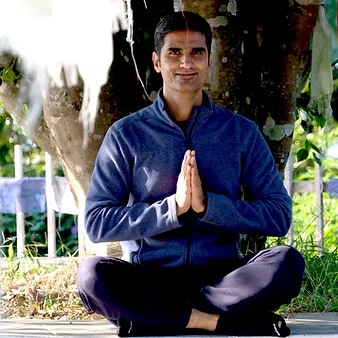
Hardik Mehta
Hardik is an E-RYT 500 & YACEP (Yoga Alliance Continuing Education Provider), Yoga Alliance, USA. He has been practicing yoga for the last 9 years. Prior to finding his true calling in Yoga, he was working with various corporates for 12 years in the Retail and eCommerce sector.