
Yoga is often introduced through asanas, pranayama, meditation, and physical discipline. But as practitioners move deeper into the yogic tradition, they encounter a much broader philosophy—one that explores the nature of existence, consciousness, transformation, and the relationship between the individual and the universe.
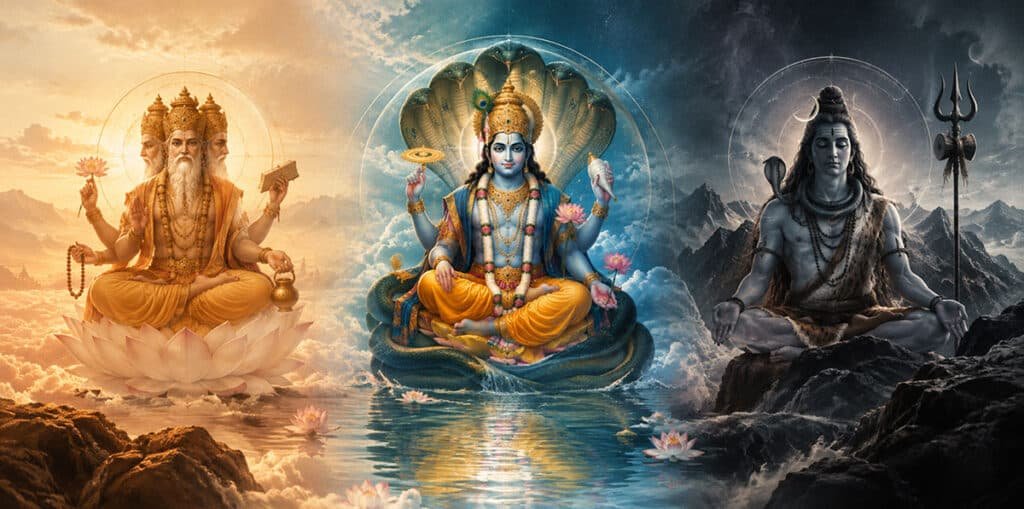
One profound concept connected to this deeper understanding is the Trinity of Brahma, Vishnu, and Mahesh, traditionally known as the Trimurti.
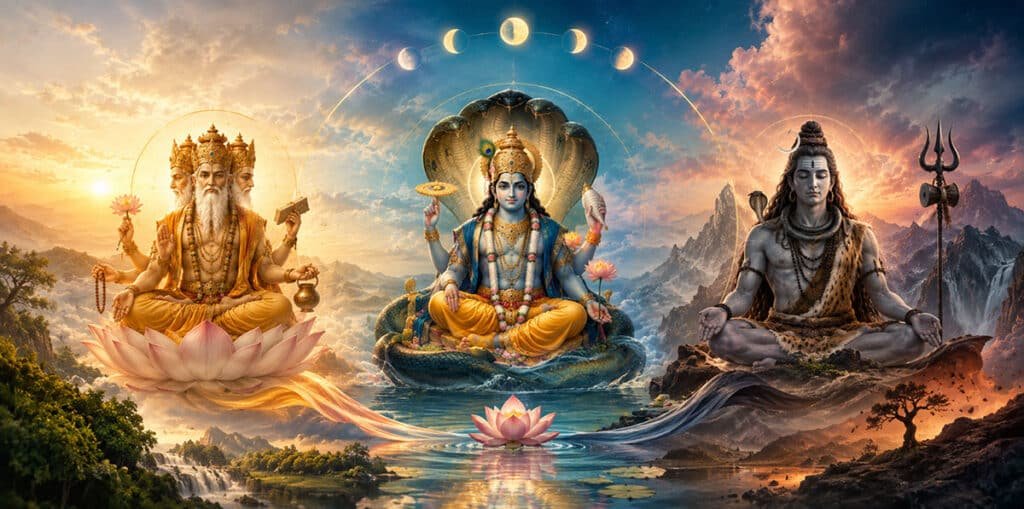
In Hindu philosophical thought, the Trimurti brings together three cosmic functions: creation, preservation, and dissolution or transformation. Brahma represents creation, Vishnu preservation, and Mahesh, or Shiva, dissolution and transformation. The concept provides a symbolic way of understanding the continuous cycles through which life and the universe move.
For students undertaking an Advanced Yoga Teacher Training Course (Advanced YTTC), understanding this concept is valuable because yoga is not merely a physical discipline. Its philosophical foundation encourages practitioners to observe life, change, action, and consciousness from a deeper perspective.
So, what does the Trinity mean in yoga, and how can its teachings become relevant to our own practice and everyday life?
Let’s explore.
What Is the Trinity in Yoga?
The word Trimurti comes from the Sanskrit idea of three forms. It brings together Brahma, Vishnu and Shiva as three important divine expressions associated with the processes of creation, preservation and dissolution.
These three principles can be understood as a continuous cycle:
Brahma → Creation
Vishnu → Preservation
Mahesh (Shiva) → Dissolution and Transformation
Importantly, dissolution should not simply be understood as destruction in a negative sense. In a cyclical understanding of existence, endings make space for renewal.
A seed grows into a plant, the plant matures, its old form eventually changes, and its seeds create new life. Similarly, relationships, habits, identities, ideas and stages of life continuously emerge, develop and transform.
The Trimurti therefore offers an important yogic lesson:
Life is not static. Everything moves through cycles of beginning, sustaining and transformation.
This perspective can profoundly influence the way a yoga practitioner approaches both practice and life.
Brahma: The Principle of Creation
Brahma represents creation—the force that brings something into existence.
From a yogic perspective, creation is not limited to the formation of the physical universe. We are constantly creating through our thoughts, intentions, choices, habits and actions.
Every yoga practice begins with an intention.
Perhaps you decide to develop a regular meditation practice. Maybe you begin studying yoga philosophy. Or perhaps you aspire to become a more compassionate and knowledgeable yoga teacher.
That first intention represents a creative impulse.
What Brahma teaches a yoga practitioner
Brahma can remind us of the importance of:
- New beginnings
- Creativity
- Knowledge
- Intention
- Learning
- Conscious action
For an aspiring yoga teacher, this principle is especially meaningful. Teaching yoga involves creating a learning environment where students can explore their bodies, breath, minds and inner awareness.
But creation requires responsibility.
A teacher is not simply creating sequences or classes. They are helping create experiences that may influence another person’s understanding of yoga.
This makes awareness and knowledge essential parts of yoga teacher training.
Vishnu: The Principle of Preservation
If Brahma represents beginning, Vishnu represents the ability to sustain and preserve.
Vishnu is traditionally associated with maintaining cosmic order and protecting dharma. His role represents continuity, stability and balance.
This principle has an obvious connection with yoga practice.
Starting yoga is relatively easy.
Maintaining a practice is much harder.
You may feel inspired after attending your first class, but the deeper benefits of yoga emerge through consistency.
A regular practitioner learns to preserve what is beneficial:
- A healthy routine
- Awareness of breath
- Discipline
- Self-study
- Mental balance
- Ethical values
- A connection with one’s inner self
Vishnu and the importance of consistency
Yoga is not about performing an impressive posture once.
It is about returning to the practice again and again.
Some days your body may feel strong. Other days it may feel tired. Some meditation sessions may feel peaceful, while others may be filled with distractions.
Preservation means continuing with awareness despite these changing experiences.
This is where discipline and consistency in yoga become important.
For a yoga teacher, Vishnu’s principle can also be reflected in maintaining the integrity of the tradition—understanding what should be preserved while adapting teaching appropriately for different students and contexts.
Mahesh or Shiva: The Principle of Dissolution and Transformation
The third aspect of the Trinity is Mahesh, or Shiva.
Shiva is often described as the destroyer, but interpreting this simply as destruction can miss the deeper significance of the concept.
In the cycle of existence, something must end for something new to emerge.
Therefore, Shiva can be understood as representing dissolution, transformation, release and renewal.
This principle is particularly relevant to yoga.
Why?
Because yoga asks us to examine what no longer serves us.
Perhaps it is an unhealthy habit.
Perhaps it is an outdated belief about ourselves.
Perhaps it is attachment, fear, ego or a pattern of thinking that prevents growth.
Yoga gives us tools to observe these patterns rather than being controlled by them.
Shiva’s symbolism therefore offers a powerful lesson:
Growth sometimes requires letting go.
The Shiva tradition is also deeply connected with yoga, meditation and the archetype of the yogi. Shiva is widely represented as an ascetic and yogic figure, and the idea of Adiyogi—the first yogi—is deeply influential in contemporary yoga traditions.
The Deeper Meaning of Brahma, Vishnu and Mahesh in Yoga
The real value of the Trimurti lies not only in understanding three divine forms but in recognising the relationship between the three principles.
Creation without preservation may remain incomplete.
Preservation without transformation may lead to stagnation.
Transformation without creation may have nothing new to emerge into.
Together, they represent a continuous movement:
Create → Sustain → Transform → Create Again
This cycle can be observed everywhere.
Consider your yoga practice.
You create a routine.
You preserve it through discipline.
You transform as your awareness develops.
Then you create a deeper version of your practice.
The same process happens in teaching.
A teacher creates a class, maintains a safe and supportive environment, observes what needs to change, and adapts the teaching accordingly.
This is one reason the Trimurti and yoga philosophy can be particularly meaningful for advanced students.
Trinity and the Yogic Understanding of Change
One of the most important lessons yoga offers is that change is inevitable.
The body changes.
The breath changes.
The mind changes.
Circumstances change.
Even our understanding of ourselves changes.
The Trimurti gives us a framework for contemplating this movement without automatically treating change as something negative.
Brahma asks: What am I creating?
Vishnu asks: What is worth preserving?
Mahesh asks: What am I ready to release or transform?
These three questions can become a practical form of self-reflection.
For example, someone may realise:
- “I am creating a more mindful daily routine.”
- “I need to preserve my commitment to self-discipline.”
- “I need to release the fear that I am not good enough.”
This transforms an ancient philosophical concept into something practical.
The Trimurti and the Life of a Yoga Teacher
For aspiring teachers, philosophy becomes meaningful when it informs the way they live and teach.
A yoga teacher constantly works with these three principles.
Creation
Teachers create classes, sequences, learning environments and opportunities for students to explore yoga.
Preservation
Teachers preserve the foundations of yoga—its discipline, ethical principles, philosophical teachings and connection to inner awareness.
Transformation
Teachers help students recognise possibilities for change while also continuing their own journey of self-study and growth.
This is why studying yoga philosophy in Advanced YTTC can extend far beyond memorising philosophical concepts.
It encourages future teachers to understand the why behind the practice.
Why Is the Trinity Important in Advanced Yoga Teacher Training?
An advanced yoga teacher should ideally understand yoga as more than a collection of physical postures.
Advanced study introduces practitioners to deeper areas such as:
- Yoga philosophy
- Meditation
- Pranayama
- Yogic anatomy
- Subtle energy
- Traditional texts
- Teaching methodology
- Self-study
- Spiritual and philosophical dimensions of yoga
Sayujya Yoga’s Advanced Holistic YTTC, for example, integrates philosophy alongside asana, pranayama, mudra, bandha, meditation, anatomy, teaching methodology and other areas of yoga education.
Understanding concepts such as the Trimurti helps students connect individual practices with a larger philosophical framework.
Instead of asking only, “How do I perform this asana?”, an advanced practitioner can begin asking:
“What is this practice teaching me about myself?”
That shift—from performance to awareness—is an important part of deeper yoga education.
Applying the Three Principles to Everyday Life
You do not need to be a scholar of Hindu philosophy to contemplate the Trimurti.
Try applying its three principles to your own life.
1. Create consciously
Ask yourself:
What am I bringing into my life?
Choose your habits, thoughts and actions with greater awareness.
2. Preserve wisely
Ask:
What deserves my continued attention?
Protect your health, relationships, values, practices and commitments that genuinely support your growth.
3. Transform courageously
Ask:
What am I holding onto that I have outgrown?
Sometimes growth requires releasing an old pattern rather than adding something new.
This simple reflection can turn the importance of Trinity in yoga into a practical philosophy for everyday living.
Understanding Unity Behind the Three
The Trimurti should not necessarily be viewed as three completely independent or competing divine powers. Different Hindu traditions interpret the relationship between these forms in different ways, and some understand them as expressions of a deeper underlying reality.
For a yoga practitioner, this offers another valuable lesson: unity can contain diversity.
Just as yoga brings together body, breath, mind and awareness, the Trimurti presents different functions within a larger cosmic framework.
The three are distinct in symbolism, yet connected through the larger cycle of existence.
This idea of interconnectedness lies beautifully alongside the broader yogic vision of seeing beyond separation.
Learn Deeper Yoga Philosophy with Sayujya Yoga
For practitioners who want to explore yoga beyond physical postures, philosophical concepts such as Brahma, Vishnu and Mahesh can open an entirely new dimension of learning.
Sayujya Yoga offers structured Yoga Teacher Training Courses, including its Advanced Holistic YTTC, where students can deepen their understanding of yoga philosophy alongside practical and theoretical aspects of yoga education. Its Advanced YTTC curriculum includes areas such as Yoga Sutra, Bhagavad Gita, principal Upanishads and Ayurveda, alongside asana, pranayama, meditation, anatomy and teaching methodology.
This makes the study of the Trimurti in yoga particularly relevant for students who want to understand yoga as a complete discipline rather than limiting it to physical movement.
When philosophy is connected with practice, ancient teachings can become more than concepts to remember. They become principles to observe, question and live.
Conclusion: Creating, Preserving and Transforming Through Yoga
The Trinity of Brahma, Vishnu and Mahesh offers a beautiful way to understand the rhythm of existence.
Brahma teaches us to create.
Vishnu teaches us to preserve.
Mahesh teaches us to transform and let go.
Together, they remind us that life is a continuous cycle rather than a fixed destination.
As yoga practitioners, we create intentions, preserve discipline and transform through self-awareness. As teachers, we create meaningful learning experiences, preserve the wisdom of the tradition and evolve our understanding through continued study.
Perhaps the deepest lesson is simple:
Creation, preservation and transformation are not separate stages of life—they are constantly happening within us.
And when yoga teaches us to observe these changes with awareness, the practice begins to move beyond the mat and into the way we understand life itself.
Hardik Mehta
Hardik is an E-RYT 500 & YACEP (Yoga Alliance Continuing Education Provider), Yoga Alliance, USA. He has been practicing yoga for the last 9 years. Prior to finding his true calling in Yoga, he was working with various corporates for 12 years in the Retail and eCommerce sector.