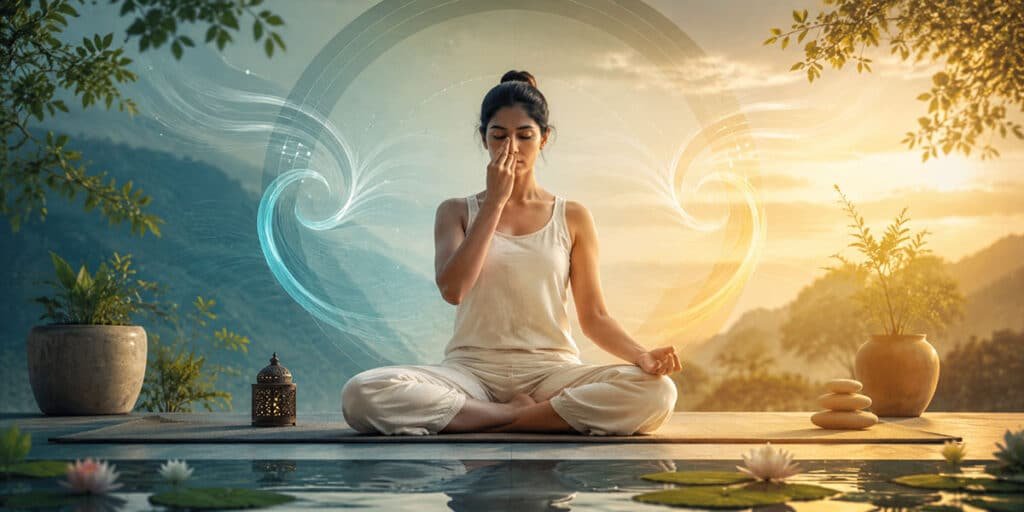
In a world filled with constant notifications, long working hours, mental pressure, and little time to pause, the simple act of breathing consciously can become a powerful practice. Anulom Vilom, one of the most widely practiced pranayama techniques in yoga, offers a structured way to slow down the breath, cultivate awareness, and bring greater steadiness to the mind.
Often described as alternate nostril breathing, Anulom Vilom involves breathing through one nostril at a time in an alternating pattern. Its simplicity makes it accessible to beginners, while its depth makes it an important practice for students pursuing a more serious understanding of yoga and pranayama.
For yoga teachers, learning Anulom Vilom is not simply about memorizing a breathing sequence. It is about understanding breath awareness, correct technique, appropriate progression, and the relationship between breath and mental state. This is why the practice has an important place in structured yoga education, including an Advanced Yoga Teacher Training Course (YTTC).
What Is Anulom Vilom?
Anulom Vilom Pranayama is a traditional yogic breathing technique in which inhalation and exhalation are performed alternately through the two nostrils.
The Sanskrit terms are commonly understood as referring to the natural or orderly flow of breath. In many modern yoga settings, Anulom Vilom is used interchangeably with Nadi Shodhana, although different yoga traditions and teaching lineages may distinguish between the two based on technique, breath retention, ratios, and other details.
At its simplest level, the practitioner gently closes one nostril, breathes through the other, switches sides, and continues the alternating pattern.
The emphasis is not on taking the biggest possible breath. Instead, the practice encourages slow, smooth, controlled and comfortable breathing.
This makes Anulom Vilom particularly valuable for developing pranayama awareness before progressing to more complex breathing practices.
Why Is Anulom Vilom Important in Yoga?
Breathing is something we do automatically, but pranayama transforms ordinary breathing into a conscious practice.
In yoga philosophy, breath is closely connected with prana, the vital energy associated with life. Traditional yogic teachings describe the nadis as subtle pathways through which prana flows, and practices such as alternate nostril breathing are traditionally associated with balancing and purifying these pathways.
From a modern physiological perspective, controlled breathing can influence cardiovascular and autonomic variables. Research on alternate nostril breathing has reported changes in measures such as blood pressure, heart rate and autonomic function. A 2024 systematic review and meta-analysis found reductions in systolic and diastolic blood pressure with alternate nostril breathing, although the researchers also noted substantial variation between studies.
This combination of traditional knowledge and emerging scientific research makes Anulom Vilom breathing an interesting subject for both yoga practitioners and yoga teachers.
How to Practice Anulom Vilom
Anulom Vilom should ideally be learnt under appropriate guidance, particularly when students are beginning pranayama.
A simple beginner-friendly sequence is:
1. Sit comfortably
Sit in a stable position such as Sukhasana, Vajrasana, or another comfortable seated posture. Keep the spine naturally upright and allow the shoulders, face and jaw to relax.
2. Prepare the hands
The right hand is traditionally used to regulate the nostrils through a mudra such as Nasagra Mudra or Vishnu Mudra. The left hand can rest comfortably on the knee.
3. Begin with a relaxed breath
Before changing the breathing pattern, take a few natural breaths. Observe the movement of the breath without trying to control it.
4. Exhale gently
Allow a comfortable exhalation before beginning the alternating pattern.
5. Inhale through one nostril
Close one nostril gently and inhale slowly through the open nostril.
6. Switch nostrils
Close the nostril through which you inhaled, open the opposite nostril and exhale slowly.
7. Continue the cycle
Inhale through the same nostril, switch again and exhale through the opposite side.
Continue for several comfortable rounds without forcing the breath.
For beginners, the priority should be quality over quantity. Breath retention or advanced ratios should not be introduced simply to make the practice more challenging. They should be taught progressively and appropriately.
Benefits of Anulom Vilom
One reason Anulom Vilom Pranayama remains popular is its combination of simplicity and versatility.
1. Encourages Relaxation
Slow, conscious breathing can help create a calmer physiological state. Research on alternate nostril breathing has found changes in autonomic and cardiovascular measures, including reductions in blood pressure in some studies.
For many practitioners, the deliberate rhythm of Anulom Vilom also creates a natural transition from an active state to a more inward-focused practice.
2. Supports Breath Awareness
Unlike unconscious breathing, pranayama requires attention. Practitioners become more aware of inhalation, exhalation, pauses, nostril dominance and the rhythm of respiration.
This awareness can become useful beyond the pranayama session itself.
3. May Support Respiratory Function
Research has explored the effects of alternate nostril breathing and other yogic breathing techniques on respiratory function. One study involving young adults reported improvements in measures including forced vital capacity, forced expiratory volume and peak expiratory flow after a four-week alternate-nostril-breathing programme.
More recent systematic research has also found generally favourable effects of yogic breathing practices on several pulmonary-function measures, although the evidence varies between techniques and studies.
4. Helps Develop Mental Focus
Anulom Vilom requires the practitioner to coordinate breath, attention and movement of the hand. This naturally encourages concentration.
Rather than allowing attention to jump between multiple thoughts, the practitioner repeatedly returns to the breath.
5. Can Become a Preparatory Practice for Meditation
The transition from active movement to stillness is not always easy. Alternate nostril breathing can serve as a bridge between physical yoga practices and meditation by giving the mind a structured object of attention.
After several quiet rounds, sitting in silence can feel more accessible.
6. May Support Cardiovascular Regulation
The cardiovascular effects of slow breathing are an active area of research. A systematic review and meta-analysis of alternate nostril breathing studies reported reductions in systolic and diastolic blood pressure compared with control conditions. However, the authors highlighted significant heterogeneity between studies, so these findings should not be interpreted as a substitute for medical treatment.
Anulom Vilom and the Nervous System
One of the most fascinating aspects of pranayama is its relationship with the autonomic nervous system.
The autonomic nervous system regulates many functions that occur without conscious effort, including heart rate, blood pressure and respiration. Because breathing can be voluntarily modified, it provides an interesting pathway through which conscious behaviour can interact with autonomic regulation.
Research has observed changes in heart-rate variability and other autonomic measures following different nostril-regulated breathing techniques.
This does not mean that Anulom Vilom should be presented as a cure for anxiety, hypertension or any medical condition. Instead, it is better understood as a yogic breathing practice that may support relaxation, breath regulation and overall wellbeing when practised appropriately.
Common Mistakes to Avoid
Even a simple pranayama can lose its benefits when technique becomes mechanical or forceful.
Some common mistakes include:
- Breathing too quickly
- Forcing the inhalation or exhalation
- Tightening the shoulders and facial muscles
- Pressing the nostrils too aggressively
- Holding the breath without proper preparation
- Trying to complete too many rounds
- Treating pranayama as a competition
- Practicing despite dizziness, discomfort or breathlessness
The goal is not to control the breath aggressively. The goal is to develop a smoother relationship with the breath.
If a practitioner experiences discomfort, dizziness or unusual breathlessness, the practice should be stopped and appropriate professional guidance sought. People with medical conditions should consult a qualified healthcare professional before beginning intensive breathing practices.
Anulom Vilom for Yoga Teacher Training
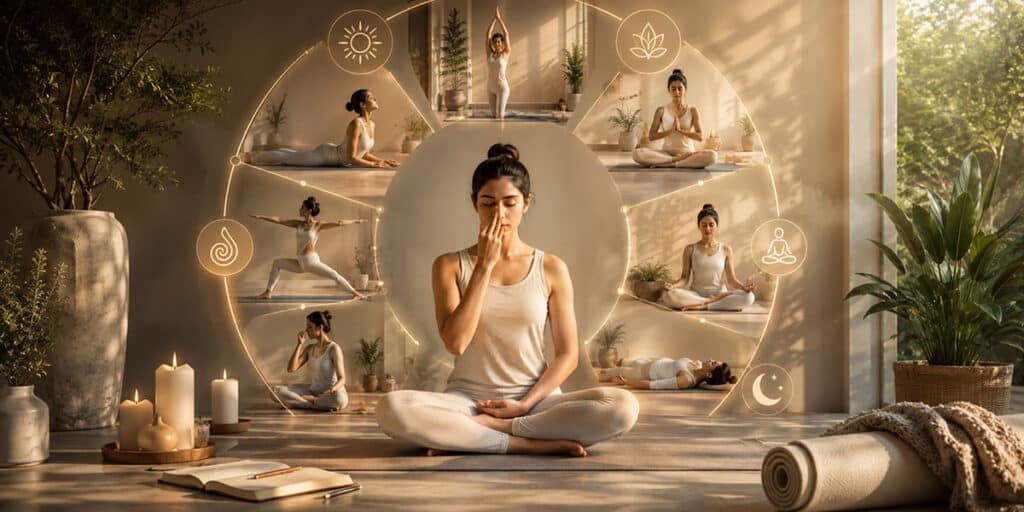
For students of an Advanced YTTC, Anulom Vilom deserves to be studied beyond the basic instruction of “inhale left, exhale right.”
A competent yoga teacher needs to understand:
- The traditional foundations of pranayama
- Correct sitting posture
- Hand positioning and nostril regulation
- Breath awareness
- Appropriate pacing
- Beginner modifications
- Contraindications and precautions
- The role of breath retention
- How to create a progressive pranayama sequence
- How to observe and guide students safely
Teaching pranayama requires sensitivity. Every student arrives with a different breathing pattern, physical capacity and level of experience. A good teacher therefore teaches the technique while also observing how the practitioner responds.
This is where structured teacher education becomes especially valuable.
Anulom Vilom in a Daily Yoga Routine
One of the biggest advantages of Anulom Vilom breathing is that it does not require elaborate equipment or a large space.
It can be incorporated into a broader yoga practice after suitable preparation and before meditation or relaxation.
A simple sequence could include:
Gentle movement → Asana practice → Quiet sitting → Anulom Vilom → Meditation → Relaxation
The exact duration and sequencing should depend on the practitioner’s experience and the broader purpose of the session.
Consistency is generally more useful than forcing a long session occasionally. A few mindful rounds performed with attention can be more valuable than rushing through a large number of rounds.
Learn the Deeper Practice at Sayujya Yoga
For those interested in moving beyond personal yoga practice and understanding how to teach yoga professionally, Anulom Vilom is an excellent example of why proper yoga education matters.
Sayujya Yoga, one of the best yoga institutes in Mumbai, offers a Teachers’ Training Program, making it relevant for students who want to explore yoga through a more structured educational approach.
An advanced yoga teacher training environment can provide the opportunity to study practices such as pranayama within a wider framework rather than learning individual techniques in isolation. Anulom Vilom can therefore be understood not merely as a breathing exercise, but as part of a teacher’s broader understanding of breath awareness, sequencing, yogic philosophy and responsible instruction.
For aspiring yoga teachers, this distinction is important: learning a practice for yourself and learning how to teach that practice are two different levels of understanding.
Final Thoughts
Anulom Vilom may look simple, but its simplicity is precisely what makes it powerful. By alternating the breath through the nostrils and maintaining a calm, attentive rhythm, practitioners can cultivate greater awareness of breathing and create space for physical and mental stillness.
Its traditional roots, practical accessibility and growing scientific interest make Anulom Vilom Pranayama an important practice for modern yoga education.
For yoga students, it can become a daily breathing ritual. For aspiring teachers, it can become a lesson in how breath, awareness and responsible instruction come together.
And ultimately, that may be the deeper lesson of pranayama: the breath does not need to be complicated to become transformative—it needs to be conscious.
Hardik Mehta
Hardik is an E-RYT 500 & YACEP (Yoga Alliance Continuing Education Provider), Yoga Alliance, USA. He has been practicing yoga for the last 9 years. Prior to finding his true calling in Yoga, he was working with various corporates for 12 years in the Retail and eCommerce sector.