
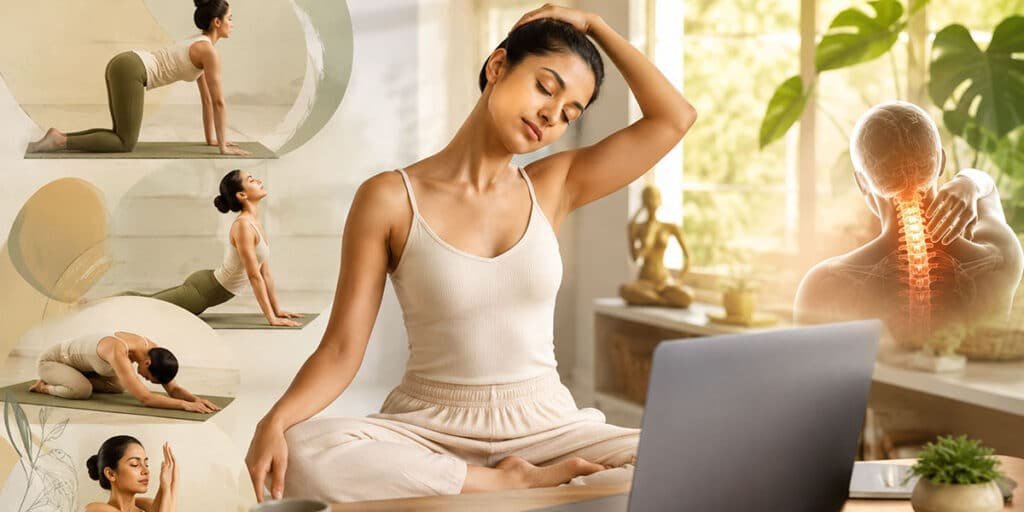
Spending hours on a laptop has become part of everyday life. Whether you work from home, study, attend online meetings, edit content, or simply spend long hours browsing, your neck can quietly absorb the strain. What begins as mild stiffness may gradually become persistent neck pain, tight shoulders, headaches, or reduced mobility.
One reason is the position we often maintain while using a laptop. The head moves forward, the shoulders round, and the upper back becomes less active. Staying in the same position for extended periods can place additional stress on the neck and surrounding muscles.
The good news is that movement matters. Yoga can be a valuable part of a balanced approach to managing neck discomfort, particularly when combined with better workstation habits and regular breaks. Research has found evidence that yoga may provide short-term improvements in neck pain, disability, mobility, and quality of life.
For students of yoga and aspiring teachers, understanding this relationship between modern lifestyle habits and traditional yoga practices is especially important. It is also why yoga for neck pain is a useful application explored within a well-rounded Advanced Yoga Teacher Training Course (YTTC).
Why Does Laptop Use Cause Neck Pain?
The human head is naturally balanced over the spine. When we sit upright, the neck does not have to work excessively to support it. However, when we lean toward a laptop screen, the head tends to move forward.
At the same time, several other patterns may develop:
- Rounded shoulders
- Forward-head posture
- Stiffness in the upper back
- Tight chest and shoulder muscles
- Reduced movement in the cervical spine
- Prolonged static sitting
- Increased muscular fatigue
The issue is not simply that a particular sitting position is “bad.” Staying in one position for too long, particularly without adequate movement, can contribute to discomfort. Guidance on nonspecific neck pain also emphasizes staying active and avoiding prolonged inactivity.
This is where yoga for computer users can become useful. Instead of focusing only on stretching the neck, yoga encourages awareness of the entire body—neck, shoulders, spine, chest, breathing, and posture.
Can Yoga Help With Laptop-Related Neck Pain?
Yes, yoga may help manage certain forms of nonspecific neck pain, although it should not be considered a universal treatment for every neck condition.
A systematic review and meta-analysis involving 10 trials and 686 participants found that yoga was associated with improvements in neck pain intensity, neck-related disability, cervical range of motion, quality of life, and mood.
More recent evidence also suggests that yoga is among several exercise approaches that can have positive short-term effects on pain and disability associated with chronic neck pain.
The important point is that yoga should be practiced intelligently. The goal isn’t to force the neck into extreme positions. Instead, a yoga sequence for neck pain should encourage gentle mobility, postural awareness, relaxation, breathing, and balanced strengthening.
7 Yoga Practices for Laptop-Related Neck Pain
The following practices can be incorporated into a gentle routine. Movements should always remain comfortable and controlled.
1. Neck Awareness and Gentle Movements
Start with simple awareness rather than immediately performing intense stretches.
Sit comfortably with the spine upright. Relax the shoulders and notice whether the chin is naturally jutting forward. Slowly bring the head toward a neutral position.
You can then practice gentle:
- Chin movements
- Turning the head from side to side
- Looking slightly up and down
- Ear-to-shoulder movements
Keep the range of motion comfortable. Avoid forcing the neck or making rapid circular movements.
This simple practice can be particularly useful as a desk yoga exercise for neck pain, because it requires very little space.
2. Marjaryasana–Bitilasana — Cat-Cow
Cat-Cow is traditionally practiced on the hands and knees and can help bring movement to the entire spine.
As you move between spinal flexion and extension, allow the neck to follow the natural movement of the spine rather than moving independently.
This is important for people who spend hours sitting because laptop work often reduces movement throughout the thoracic spine as well as the neck.
Rather than thinking only about “stretching the neck,” think about restoring movement through the whole spine.
3. Bhujangasana — Gentle Cobra Pose
A carefully modified Cobra Pose can encourage spinal extension and help counter the tendency to remain rounded over a laptop.
Lie on your abdomen with your hands placed near the chest. Lift the chest gently while keeping the shoulders relaxed and away from the ears.
Do not throw the head backward.
The movement should come primarily through the upper spine, while the neck remains long and comfortable.
For beginners, a low Cobra or gentle sphinx variation may be more appropriate.
4. Balasana — Child’s Pose
Child’s Pose offers an opportunity to slow down and release muscular tension.
From a kneeling position, gently fold forward and allow the forehead to rest comfortably. Keep the shoulders relaxed and breathe slowly.
For people with sensitive knees or difficulty sitting back toward the heels, modifications can be used.
The value of this practice isn’t simply physical stretching. Slow breathing and a supported position can also encourage relaxation after long periods of screen-based work.
5. Garudasana Arms — Eagle Arms
Laptop users frequently experience tension around the shoulders and upper back. Eagle Arms can be incorporated into a seated or standing sequence to create movement around the shoulder blades and upper back.
Bring the arms forward and cross one arm over the other. Depending on mobility, you may bring the palms together or simply hold opposite shoulders.
Keep the shoulders relaxed.
Practice on both sides and avoid forcing the arms into position.
This makes yoga for stiff shoulders and neck particularly practical for people whose discomfort extends beyond the cervical region.
6. Gentle Chest-Opening Movements
Long hours at a laptop often involve a forward-reaching arm position. Introducing gentle chest-opening movements can help balance the practice.
You can interlace the fingers behind the back and gently draw the shoulders back, or practice a simple standing chest opener.
The intention is not to aggressively pull the shoulders backward. Instead, focus on creating space across the chest while maintaining comfortable breathing.
Pairing chest opening with upper-back mobility can make a yoga routine for neck and shoulder pain more comprehensive.
7. Nadi Shodhana and Relaxed Breathing
Neck discomfort isn’t always purely physical. Long working hours, deadlines, meetings, and constant screen exposure can also contribute to stress and muscular tension.
A few minutes of slow, comfortable breathing can therefore complement physical yoga practices.
Nadi Shodhana, or alternate nostril breathing, may be incorporated into a suitable yoga session under proper guidance. The emphasis should be on relaxed, effortless breathing rather than breath retention or force.
For a short workplace routine, even a few minutes of slow diaphragmatic breathing can provide a useful transition between work and rest.
A Simple 10-Minute Yoga Routine for Laptop Users
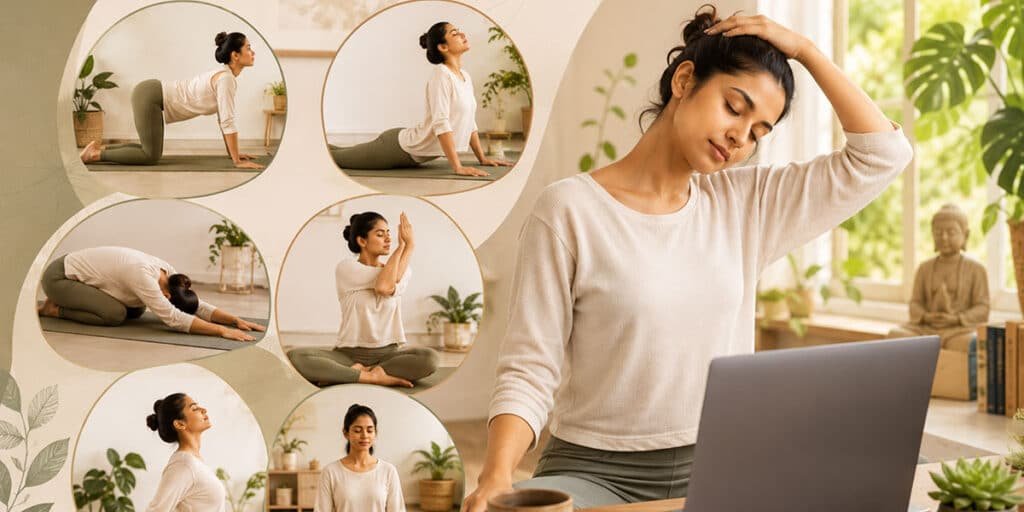
If you spend most of your day at a desk, consistency is more useful than an occasional long session.
Try this simple sequence:
1 minute: Sit upright and observe your posture and breathing
1 minute: Gentle neck movements
2 minutes: Cat-Cow
1 minute: Gentle Cobra or Sphinx
2 minutes: Eagle Arms and shoulder movements
2 minutes: Child’s Pose
1 minute: Slow, relaxed breathing
The sequence can be modified according to individual needs.
However, yoga should not become another activity performed while ignoring discomfort. If a movement increases pain, stop and modify it.
Don’t Forget Your Laptop Setup
Yoga can support mobility and body awareness, but it cannot compensate for an unsuitable work environment indefinitely.
Along with your neck pain yoga exercises, consider improving your workstation habits:
- Keep the screen at a comfortable viewing height.
- Avoid continuously looking downward at the laptop.
- Support your lower back when seated.
- Keep your feet comfortably supported.
- Relax your shoulders rather than constantly lifting them.
- Change positions regularly.
- Take short movement breaks during extended work sessions.
- Avoid working for several hours without getting up.
The goal is not to maintain a “perfect posture” all day. Instead, create opportunities for your body to move and change position.
Clinical guidance for neck pain similarly emphasizes maintaining activity and using appropriate movement and exercise rather than relying solely on passive approaches.
When Should You Avoid Yoga for Neck Pain?
Yoga is not appropriate as a substitute for medical assessment when neck symptoms may indicate a more serious problem.
Seek professional medical advice if neck pain is severe, worsening, follows a significant injury, or is accompanied by symptoms such as numbness, weakness, or other new neurological symptoms. Clinical guidelines recommend further evaluation when symptoms worsen or new physical symptoms develop.
For yoga teachers, this distinction is essential. A teacher’s role is not to diagnose a student’s condition. Instead, teachers should understand their scope of practice, offer appropriate modifications, and refer students to qualified healthcare professionals when necessary.
Why Neck Care Belongs in Yoga Teacher Education
Modern yoga teaching increasingly requires an understanding of how people actually live.
A student may not arrive at a yoga class with an athletic background or a perfectly balanced lifestyle. They may be a software professional, designer, student, entrepreneur, or remote worker who spends eight or ten hours a day in front of a screen.
Understanding therapeutic yoga for neck pain, posture, movement patterns, breathing, contraindications, and modifications allows teachers to create more thoughtful and responsible practices.
This is particularly relevant in an Advanced YTTC, where yoga can be explored beyond simply learning postures. Students can develop a deeper understanding of how asana, pranayama, anatomy, alignment, awareness, and lifestyle practices can be integrated into teaching.
Learn More with Sayujya Yoga
Sayujya Yoga, one of the best yoga institutes in Mumbai, offers a valuable connection to this broader approach to yoga education through its Teacher Training Program.
For someone interested in understanding how yoga can be taught with greater depth and awareness, topics such as posture, movement, anatomy, breathing, modifications, and the practical application of yoga are highly relevant. Learning how to approach everyday concerns—such as the stiffness associated with prolonged desk work—can help future teachers develop a more informed teaching perspective.
The focus is therefore not simply on teaching someone a collection of poses for neck pain. It is about understanding why a practice may be appropriate, how to adapt it, when to avoid it, and how to guide students responsibly.
For aspiring yoga teachers, this broader perspective can transform yoga from a sequence of postures into a thoughtful educational practice.
Final Thoughts
Laptop-related neck discomfort is increasingly common in a screen-focused world. Fortunately, the answer doesn’t have to be complicated.
Regular movement, better workstation habits, mindful breathing, and an appropriate yoga practice can work together to support neck and upper-body health. Research provides encouraging evidence that yoga may help reduce pain and improve function in people with chronic nonspecific neck pain, particularly in the short term.
The most important principle is simple: don’t wait for your body to demand a break. Build movement into your day.
For yoga teachers, this is an even deeper lesson. The practice should meet people where they are—and in today’s world, that often means meeting them at their laptop.
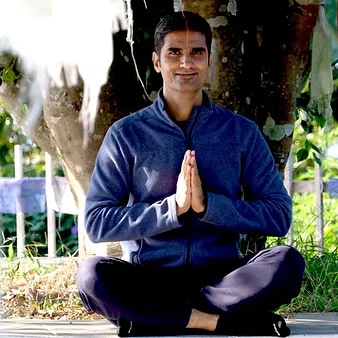
Hardik Mehta
Hardik is an E-RYT 500 & YACEP (Yoga Alliance Continuing Education Provider), Yoga Alliance, USA. He has been practicing yoga for the last 9 years. Prior to finding his true calling in Yoga, he was working with various corporates for 12 years in the Retail and eCommerce sector.