
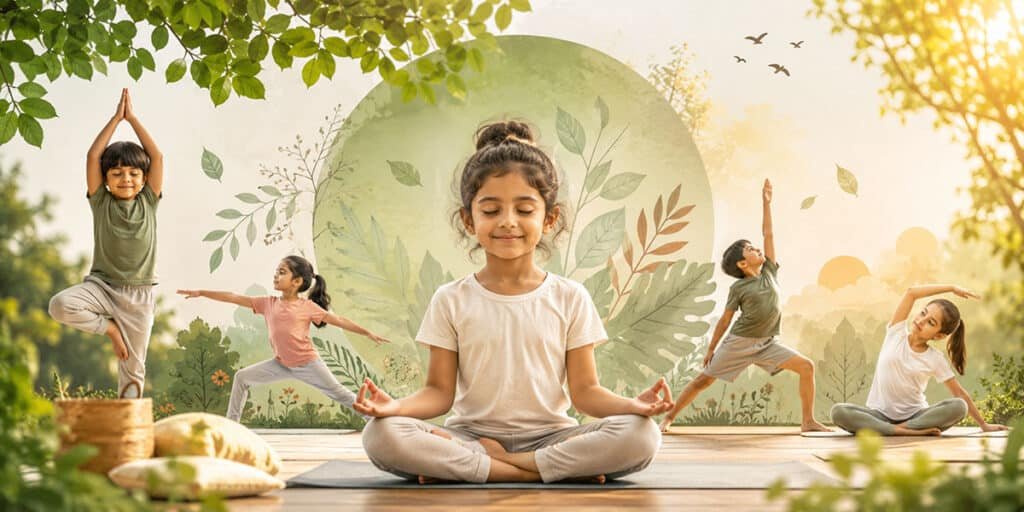
Childhood is a time of constant learning, movement, curiosity, and emotional growth. From schoolwork and extracurricular activities to screen time and social pressures, children today experience a surprisingly busy lifestyle. Amid all this stimulation, creating space for movement, mindfulness, and relaxation can make a meaningful difference.
This is where yoga for children can become a valuable practice.
Unlike competitive sports, yoga does not require children to be the fastest, strongest, or most flexible. Instead, it encourages them to understand their bodies, notice their breath, develop concentration, and become more aware of their emotions. Research on yoga interventions for children and adolescents has reported promising benefits across areas such as cognitive functioning, self-control, relaxation, and overall well-being, although researchers also note that more high-quality studies are needed.
Whether introduced at home, in schools, or through age-appropriate yoga classes, children’s yoga can offer tools that support healthy development—both on and off the mat.
What Is Yoga for Children?
Yoga for children is not simply an adult yoga class made easier. It should be adapted to a child’s age, attention span, physical development, interests, and emotional needs.
A children’s yoga session may combine:
- Simple yoga poses or asanas
- Age-appropriate breathing exercises
- Balance and coordination activities
- Relaxation techniques
- Mindfulness exercises
- Stories, games, or creative movement
- Simple meditation and visualisation
The emphasis should be on exploration rather than perfection. A child does not need to achieve a picture-perfect pose to benefit from yoga.
The goal is to make movement enjoyable while gradually developing body awareness, concentration, emotional regulation, and healthy breathing habits.
1. Improves Flexibility and Physical Mobility
One of the most obvious benefits of yoga for children is its contribution to physical movement.
Children are naturally active, but regular yoga introduces them to different movement patterns and encourages them to explore their range of motion in a controlled way. Gentle poses can help children become more aware of their spine, shoulders, hips, legs, and posture.
Practices such as Cat-Cow, Child’s Pose, Butterfly Pose, Tree Pose, and gentle standing sequences can introduce mobility and balance in an enjoyable manner.
Rather than encouraging children to push their bodies into extreme stretches, children’s yoga should focus on comfortable, functional movement and awareness.
2. Builds Balance, Coordination, and Body Awareness
Children are constantly developing their motor skills. Yoga can complement this development by asking them to coordinate movement, breathing, balance, and attention.
Balance poses such as Tree Pose can encourage children to:
- Focus on one point
- Stabilize their body
- Become aware of their posture
- Develop coordination
- Practice patience
Falling out of a balance pose can actually become part of the learning process. Children discover that losing balance is not failure—it is simply an invitation to try again.
This can make yoga a powerful way to introduce mindful movement for kids.
3. Supports Concentration and Focus
Children’s attention is constantly being pulled in different directions. School lessons, digital devices, notifications, games, and social interactions can make sustained attention challenging.
Yoga introduces moments where children are encouraged to slow down and pay attention to one thing at a time.
For example, a teacher might ask children to notice:
“Can you feel your breath?”
“Can you balance without looking around?”
“Can you hear the sounds around you?”
Simple practices like these can encourage present-moment awareness.
Research reviewing school-based yoga interventions has found encouraging evidence for potential psychological and cognitive benefits, including areas such as mood, anxiety, self-esteem, and memory, although the quality and consistency of evidence vary between studies.
4. Helps Children Manage Everyday Stress
Children may experience stress from school expectations, examinations, friendships, family situations, or simply the pressure of keeping up with a busy routine.
Yoga does not eliminate these challenges, but it can introduce healthy ways of responding to them.
Slow breathing, gentle movement, and relaxation can create a pause between an emotion and a reaction.
For example, teaching a child to take several slow breaths when they feel overwhelmed gives them a simple tool they can potentially use before an exam, during a disagreement, or after a difficult day.
Reviews of yoga for children and adolescents have reported promising findings around relaxation, self-control, well-being, and mental health, while also emphasizing the need for stronger research.
5. Encourages Emotional Awareness
Yoga is not only about physical flexibility. It can also encourage children to become more aware of how they feel.
During a yoga class, children can learn to recognize sensations such as:
- Tension
- Tiredness
- Excitement
- Restlessness
- Calmness
- Frustration
A teacher can help children understand that emotions are experiences they can notice without immediately reacting to them.
This can gradually introduce the concept of emotional regulation for children.
The intention is not to teach children to suppress emotions. Instead, yoga can give them opportunities to observe emotions and respond with greater awareness.
6. Develops Confidence and Self-Esteem
Children often compare themselves with others. Yoga offers a different perspective.
There is no requirement to perform better than the child next to them. One child may have excellent balance while another may be naturally comfortable with breathing exercises. Each child can progress at their own pace.
This makes yoga a potentially positive environment for developing confidence.
A child who initially struggles with Tree Pose, for instance, may eventually discover that they can hold it for several breaths. That small achievement can reinforce an important lesson:
Progress does not have to be perfect to be meaningful.
Recent research examining yoga and body-image outcomes in children and adolescents found generally positive but small and inconsistent effects from yoga-only interventions, while multi-component programs showed more consistent promise.
7. Introduces Healthy Breathing Habits
Breathing is one of the simplest yet most powerful components of yoga.
Age-appropriate breathing exercises can help children become aware of the relationship between breath, movement, and their state of mind.
A child may notice that rapid breathing accompanies excitement or nervousness, while slower breathing can feel calming.
Simple practices such as gentle belly breathing or counting breaths can be introduced without making the practice complicated.
For younger children, breathing exercises can even become playful—for example, pretending to smell a flower while slowly breathing in and gently blowing out like a candle.
This makes yoga breathing exercises for children accessible and memorable.
8. Supports Relaxation and Better Rest
Children need sufficient rest for healthy development, yet busy schedules and stimulation can make winding down difficult.
A short relaxation practice before bedtime may help create a calmer transition from activity to rest.
Practices might include:
- Gentle stretching
- Slow breathing
- Guided visualization
- Child’s Pose
- Legs-up-the-wall variations when appropriate
- Short Yoga Nidra-inspired relaxation
The purpose is not to promise that yoga will solve sleep problems, but to establish a calming routine.
Research reviews have identified relaxation and sleep as areas of interest in studies of yoga for children and adolescents.
9. Teaches Patience and Self-Discipline
Yoga teaches children that meaningful progress takes time.
A pose may feel difficult today and become easier after regular practice. Balance may improve gradually. Breathing may become more controlled with experience.
These small lessons can translate into a broader understanding of patience and consistency.
Yoga therefore becomes more than physical exercise. It can introduce children to the idea that practice, awareness, and patience can support growth.
10. Makes Movement Fun and Non-Competitive
Perhaps one of the most important benefits of children’s yoga is that it can make movement enjoyable without turning it into a competition.
A thoughtfully designed children’s yoga class can use animal-inspired poses, stories, music, games, imagination, and partner activities to keep children engaged.
For example:
Lion Pose → confidence and playful expression
Butterfly Pose → gentle mobility
Tree Pose → balance
Cat-Cow → spinal movement
Cobra Pose → playful storytelling
When children associate physical activity with curiosity and enjoyment, they may be more likely to develop a positive relationship with movement.
How to Introduce Yoga to Children
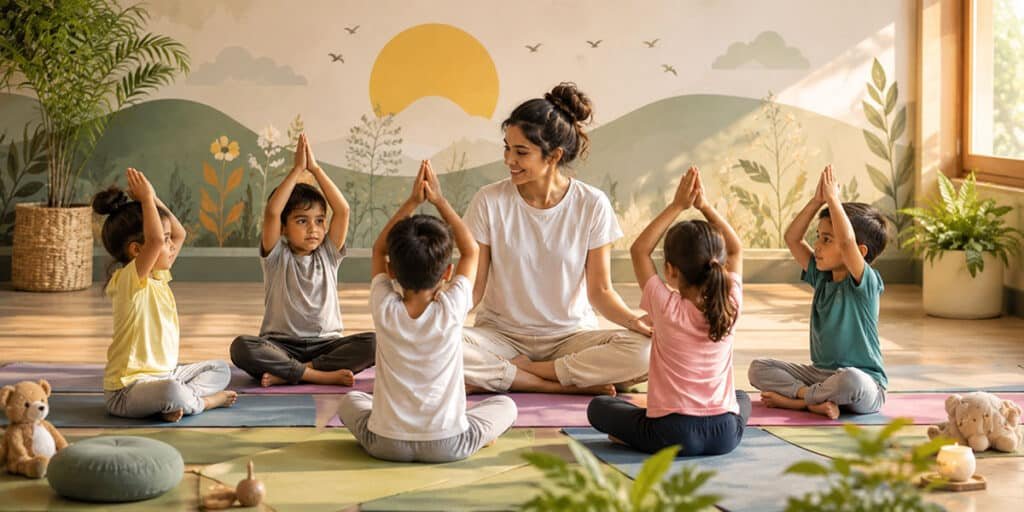
The approach matters just as much as the practice.
A children’s yoga session should generally be:
Age-appropriate
The physical and mental demands should match the child’s developmental stage.
Playful
Children learn effectively through imagination, games, stories, and exploration.
Short and engaging
Young children may not benefit from long periods of stillness. Activities should change naturally.
Non-competitive
Avoid comparing flexibility, strength, balance, or performance.
Safe
Children should never be forced into a posture or encouraged to push through pain.
Inclusive
Yoga should accommodate different physical abilities, personalities, and experience levels.
Parents and teachers should also remember that yoga is a complementary wellness practice, not a replacement for appropriate medical or psychological care when a child needs professional support.
Why Teaching Children Yoga Requires Special Understanding
Teaching yoga to children requires more than knowing a collection of yoga poses.
A teacher needs to understand child development, age-appropriate sequencing, communication, safety, anatomy, attention spans, and teaching methodology.
This is particularly relevant for yoga teachers undertaking advanced training. Learning how to modify practices for different populations is an important part of becoming a responsible and adaptable teacher.
For example, the way a teacher introduces breathing to a five-year-old should be very different from how they explain pranayama to an adult practitioner.
This is where deeper yoga education becomes valuable.
Learning and Teaching Yoga with Sayujya Yoga
For aspiring yoga teachers who want to deepen their understanding of yoga beyond physical postures, Sayujya Yoga, one of the best yoga institutes in Mumba, offers structured Yoga Teacher Training programs that connect traditional yogic knowledge with anatomy, physiology, philosophy, and teaching methodology.
Its 200-hour Yoga Teacher Training Course and 300-hour Advanced Holistic Yoga Teacher Training Course are designed for practitioners and teachers who already have foundational training and want to deepen their personal practice, theoretical understanding, and teaching skills. The curriculum includes areas such as asana, pranayama, meditation, anatomy, philosophy, teaching methodology, and therapeutic applications.
This broader understanding is especially relevant when teaching diverse groups, including children. A knowledgeable teacher needs to understand that yoga cannot be taught through a one-size-fits-all approach. Age, physical development, learning style, attention span, and individual needs all influence how a practice should be presented.
Sayujya Yoga’s teacher training approach emphasizes the connection between philosophy, physiology, and pedagogy, helping students move beyond simply performing asanas toward understanding how yoga can be taught thoughtfully and safely.
For those interested in becoming more capable yoga educators, this depth of study can provide a stronger foundation for designing meaningful practices for different populations.
Final Thoughts
The benefits of yoga for children extend far beyond flexibility.
With the right approach, yoga can help children explore movement, balance, breathing, concentration, relaxation, self-awareness, and confidence. It can give them a quiet space in an increasingly busy world and introduce skills that may remain valuable as they grow.
Most importantly, children’s yoga should never feel like another academic obligation or performance test.
It should feel like an opportunity to move, breathe, explore, and simply be present.
When yoga is taught with patience, creativity, and an understanding of the child’s needs, the mat can become more than a place to practise poses—it can become a space where children learn to connect with themselves.
Hardik Mehta
Hardik is an E-RYT 500 & YACEP (Yoga Alliance Continuing Education Provider), Yoga Alliance, USA. He has been practicing yoga for the last 9 years. Prior to finding his true calling in Yoga, he was working with various corporates for 12 years in the Retail and eCommerce sector.