
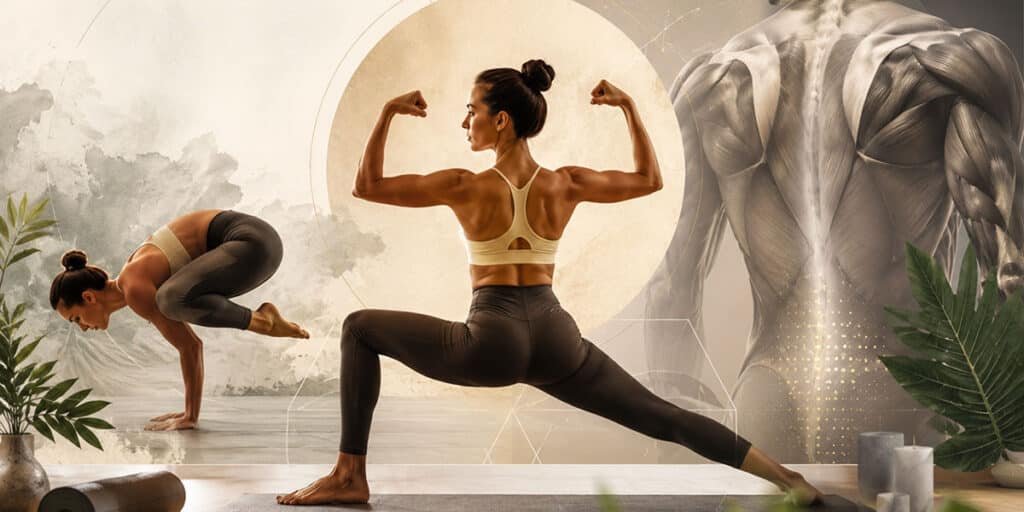
Have you ever wondered if yoga can do more than improve flexibility and reduce stress? While yoga is often associated with relaxation and mindfulness, it can also be a powerful tool for developing muscular strength. In recent years, fitness enthusiasts, athletes, and yoga practitioners have started recognising yoga as an effective way to build lean muscle, improve endurance, and enhance overall body control.
So, can you build muscle with yoga? The answer is yes—but it depends on how you practise.
In this blog, we’ll explore how yoga helps develop muscle, which styles are most effective for strength, the science behind muscle growth through yoga, and why this topic is becoming an important part of advanced yoga education.
Can Yoga Really Build Muscle?
The simple answer is yes. Yoga can help build muscle by placing your body under resistance, requiring your muscles to contract, stabilise, and support your body weight.
Unlike lifting dumbbells or barbells, yoga primarily uses bodyweight resistance. Holding challenging poses for extended periods forces muscles to work continuously, leading to strength gains and muscular endurance.
However, yoga builds muscle differently than traditional weight training.
Weightlifting often focuses on increasing muscle size (hypertrophy) through heavy resistance. Yoga, on the other hand, develops:
- Lean muscle mass
- Functional strength
- Muscular endurance
- Joint stability
- Balance and coordination
- Core strength
The result is a strong, athletic, and well-balanced body rather than simply larger muscles.
How Does Yoga Build Muscle?
Muscles grow when they experience stress that causes tiny tears in muscle fibres. During recovery, these fibres repair and become stronger.
Many yoga postures create this same stimulus by requiring muscles to:
- Hold your body weight
- Resist gravity
- Maintain alignment
- Stabilise joints
- Control slow, deliberate movement
For example, holding Chair Pose for one minute can significantly challenge the thighs and glutes, while Plank Pose strengthens the chest, shoulders, arms, and core simultaneously.
Repeated practice encourages muscles to adapt and become stronger over time.
The Types of Muscle Strength Yoga Develops
Yoga doesn’t only target one type of strength. Instead, it develops multiple forms that support everyday movement and athletic performance.
1. Isometric Strength
Many yoga poses involve holding a position without changing muscle length.
Examples include:
- Plank
- Side Plank
- Chair Pose
- Warrior II
These poses strengthen muscles through sustained contractions.
2. Functional Strength
Yoga trains muscles to work together instead of isolating a single muscle group.
This improves:
- Movement efficiency
- Athletic performance
- Daily activities
- Injury prevention
Functional strength is especially valuable because it translates directly into real-life movement.
3. Core Strength
Almost every yoga posture activates the core.
A strong core supports:
- Better posture
- Spinal stability
- Improved balance
- Reduced lower back pain
- Greater control in advanced poses
Unlike endless crunches, yoga strengthens deep stabilising muscles that are often neglected in conventional workouts.
Best Yoga Styles for Building Muscle
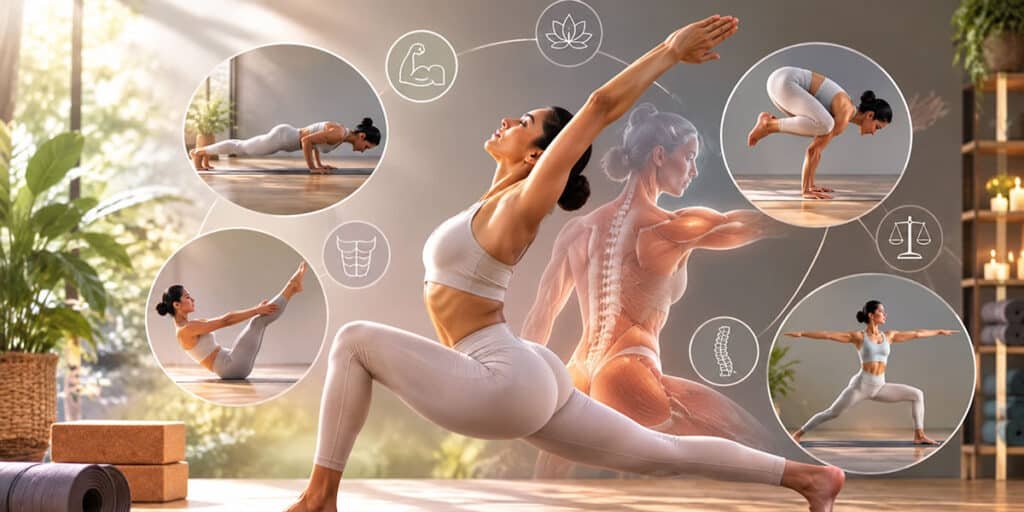
Not every yoga class focuses on strength. Some styles are particularly effective for muscle development.
Power Yoga
Power Yoga combines dynamic movement with strength-building postures.
Benefits include:
- Increased muscle endurance
- Full-body conditioning
- Higher calorie burn
- Greater upper-body strength
Ashtanga Yoga
Ashtanga follows a structured sequence of physically demanding poses linked with breath.
Regular practice develops:
- Arm strength
- Leg strength
- Shoulder stability
- Core endurance
Vinyasa Yoga
Vinyasa continuously flows between postures, creating strength while improving cardiovascular fitness.
Frequent transitions increase muscular endurance throughout the entire body.
Hatha Yoga
Although slower, Hatha Yoga often includes longer pose holds that strengthen muscles through sustained effort.
It is particularly effective for beginners learning proper alignment.
Yoga Poses That Help Build Muscle
Several yoga postures challenge major muscle groups throughout the body.
Plank Pose
Strengthens:
- Chest
- Shoulders
- Triceps
- Core
- Back
Chaturanga Dandasana
Often called the yoga push-up, this pose builds:
- Arms
- Chest
- Shoulders
- Core
It requires significant upper-body control.
Chair Pose (Utkatasana)
Targets:
- Quadriceps
- Hamstrings
- Glutes
- Calves
Holding this posture builds powerful lower-body endurance.
Warrior II
This classic standing pose strengthens:
- Legs
- Hips
- Glutes
- Core
- Shoulders
Boat Pose (Navasana)
Excellent for:
- Abdominal muscles
- Hip flexors
- Lower back stabilisers
Crow Pose (Bakasana)
An advanced arm balance that develops:
- Wrists
- Arms
- Shoulders
- Core
- Balance
Yoga vs Weight Training for Muscle Growth
One common question is whether yoga can replace the gym.
The answer depends on your goals.
|
Yoga |
Weight Training |
|
Uses bodyweight resistance |
Uses external resistance |
|
Builds lean muscle |
Maximises muscle size |
|
Improves mobility |
May require separate mobility work |
|
Enhances balance and flexibility |
Focuses primarily on strength |
|
Develops functional movement |
Excellent for progressive overload |
If your goal is bodybuilding, weight training remains more effective.
If your goal is balanced fitness, functional strength, and sustainable movement, yoga provides outstanding benefits.
Many athletes successfully combine both.
Can Beginners Build Muscle Through Yoga?
Absolutely.
Beginners often experience rapid improvements because the body is adapting to a completely new type of movement.
Consistent practice helps improve:
- Muscle activation
- Joint stability
- Body awareness
- Balance
- Strength
The key is practising regularly and gradually increasing the challenge.
Tips for Building More Muscle with Yoga
If muscle growth is your goal, consider these strategies:
Practise Consistently
Aim for at least 3–5 sessions per week.
Consistency matters more than occasional intense practice.
Hold Poses Longer
Longer holds increase muscular tension and endurance.
Try maintaining challenging poses for 30–60 seconds.
Progress Gradually
As your strength improves:
- Add more advanced variations.
- Increase holding time.
- Practise arm balances.
- Include inversions under proper guidance.
Focus on Alignment
Correct alignment ensures the intended muscles work efficiently while reducing injury risk.
Support Recovery
Muscles grow during recovery.
Prioritise:
- Quality sleep
- Adequate hydration
- Balanced nutrition
- Sufficient protein intake
The Importance of Muscle Strength in Yoga Practice
Strength is not separate from yoga—it supports every aspect of practice.
Greater muscular strength helps practitioners:
- Improve posture
- Protect joints
- Perform advanced asanas safely
- Increase balance and stability
- Develop better breath control
- Maintain healthy movement patterns
As students progress into advanced yoga, strength becomes increasingly essential rather than optional.
This is one reason why advanced yoga education places considerable emphasis on intelligent strength-building practices alongside flexibility and mindfulness.
Common Myths About Building Muscle with Yoga
Myth 1: Yoga Is Only Stretching
While stretching is part of yoga, many postures require substantial muscular effort and endurance.
Myth 2: Yoga Cannot Build Upper Body Strength
Poses like Plank, Chaturanga, Crow, and Handstand challenge the arms, shoulders, chest, and back effectively.
Myth 3: Only Heavy Weights Build Muscle
Bodyweight resistance can also stimulate muscle growth, especially when exercises become progressively more challenging.
Myth 4: Flexibility and Strength Cannot Coexist
Yoga demonstrates that flexibility and strength complement one another. Strong muscles support deeper, safer ranges of motion.
Why Understanding Strength Is Important in Advanced Yoga Teacher Training
For aspiring yoga teachers, understanding the relationship between yoga and muscle development is essential. Modern students often seek yoga not only for relaxation but also for improved fitness, resilience, and overall physical performance.
A comprehensive teacher training programme explores:
- Functional anatomy
- Biomechanics of yoga postures
- Safe alignment principles
- Progressive sequencing
- Strength and mobility integration
- Injury prevention techniques
This knowledge enables teachers to create well-rounded classes that support practitioners of different abilities while maintaining the traditional foundations of yoga.
Learn Advanced Yoga at Sayujya Yoga
If you’re passionate about deepening your understanding of yoga beyond the physical postures, Sayujya Yoga offers an enriching learning environment through its Advanced Yoga Teacher Training Course (Advanced YTTC).
The curriculum goes beyond teaching asanas by helping future yoga teachers understand anatomy, alignment, biomechanics, intelligent sequencing, philosophy, breathwork, and advanced teaching methodologies. Topics such as building functional strength through yoga are explored within a broader framework of safe and effective practice, enabling trainees to confidently guide students with diverse goals.
Whether you wish to refine your personal practice or build the knowledge required to teach professionally, the Advanced YTTC at Sayujya Yoga provides a structured pathway to expand both practical skills and theoretical understanding while honouring the authentic principles of yoga.
Final Thoughts
So, can you build muscle with yoga? Without a doubt, yes.
Yoga may not replace heavy weightlifting for maximum muscle size, but it offers something equally valuable: lean muscle development, functional strength, mobility, stability, and body awareness—all within a holistic practice that also nurtures the mind.
Whether you’re a beginner looking to get stronger or an aspiring yoga teacher exploring advanced training, incorporating strength-focused yoga into your routine can transform how your body moves, feels, and performs. With consistent practice and proper guidance, yoga becomes much more than a stretching routine—it becomes a complete system for building resilient, capable, and balanced strength
Hardik Mehta
Hardik is an E-RYT 500 & YACEP (Yoga Alliance Continuing Education Provider), Yoga Alliance, USA. He has been practicing yoga for the last 9 years. Prior to finding his true calling in Yoga, he was working with various corporates for 12 years in the Retail and eCommerce sector.