
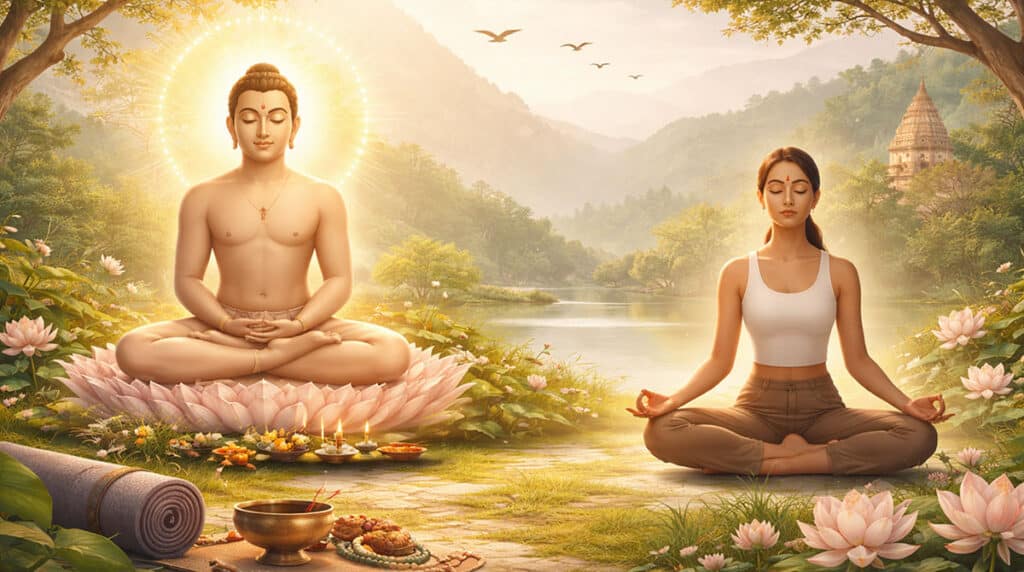
Every year, millions across India and around the world celebrate Mahavir Jayanti, the birth anniversary of Mahavira, the 24th Tirthankara of Jainism. The day is marked with prayers, processions, charity, and reflections on non-violence, truth, and self-discipline.
But beyond rituals and celebrations lies a deeper spiritual opportunity—an invitation to align our thoughts, actions, and lifestyle with principles that promote inner peace and harmony. This is where yoga and Mahavir Jayanti connect beautifully.
Yoga is not just a physical exercise; it is a way of life rooted in discipline, awareness, and compassion. When we explore the teachings of Mahavira through the lens of yoga, we discover a powerful roadmap for mental clarity, emotional balance, and spiritual growth.
Let’s explore how Mahavir Jayanti and yoga complement each other and how you can integrate both into your life.
The Spiritual Essence of Mahavir Jayanti
Mahavir Jayanti commemorates the birth of Lord Mahavira, who was born in Kundagrama (present-day Bihar). He renounced worldly comforts at the age of 30 and attained enlightenment after years of meditation and severe penance.
His teachings revolve around five core principles:
- Ahimsa (Non-violence)
- Satya (Truthfulness)
- Asteya (Non-stealing)
- Brahmacharya (Celibacy or self-control)
- Aparigraha (Non-possessiveness)
These principles are not limited to religion; they are universal guidelines for mindful living. Interestingly, these values strongly resonate with yogic philosophy.
The Yogic Connection: Jain Philosophy & Yoga
The foundation of yoga, as described in the ancient texts, includes ethical disciplines known as Yamas and Niyamas. The first of the Yamas is Ahimsa—non-violence—exactly the same principle emphasized by Mahavira.
The striking parallels between Jain philosophy and yoga include:
- Ahimsa (Non-violence) – Practicing kindness toward all beings.
- Satya (Truthfulness) – Living authentically and honestly.
- Aparigraha (Non-attachment) – Letting go of excessive material desires.
- Self-discipline and meditation – Core aspects of both traditions.
Both paths aim for self-realization, inner purity, and liberation from suffering.
While Jainism approaches this through strict ethical living and renunciation, yoga offers a structured system of practices—physical postures (asanas), breathing techniques (pranayama), meditation, and moral codes—to achieve the same ultimate goal.
How Yoga Reflects Mahavira’s Teachings
1. Ahimsa in Daily Practice
In yoga, Ahimsa begins on the mat. It means:
- Avoiding strain or injury
- Respecting your body’s limits
- Cultivating self-compassion
Off the mat, it extends to how we treat others, animals, and the environment. Many yoga practitioners choose plant-based diets, aligning with the Jain emphasis on non-violence.
On Mahavir Jayanti, practicing mindful yoga becomes a living tribute to this value.
2. Aparigraha & Minimalism
Modern life encourages accumulation—more possessions, more achievements, more comparisons. Mahavira’s message of Aparigraha teaches us to detach from material excess.
Yoga reinforces this through:
- Simplicity in lifestyle
- Awareness of consumption
- Gratitude practices
- Letting go of mental clutter
Celebrating Mahavir Jayanti with a decluttered mind and environment can be transformative.
3. Meditation & Self-Realization
Lord Mahavira attained enlightenment through intense meditation. Yoga similarly places meditation at its highest level.
Practices such as:
- Mindfulness meditation
- Breath awareness
- Mantra chanting
- Silent reflection
help cultivate the same inner stillness and awareness that Mahavira embodied.
On Mahavir Jayanti, dedicating time to meditation deepens the spiritual meaning of the celebration.
Celebrating Mahavir Jayanti Through Yoga
Here are practical ways to blend Mahavir Jayanti and yoga into a meaningful experience:
 1. Begin the Day with a Gratitude Meditation
Reflect on compassion, forgiveness, and kindness. Set an intention to practice non-violence in thought and action.
 2. Practice a Gentle Yoga Flow
Focus on heart-opening poses like:
- Bhujangasana (Cobra Pose)
- Anahatasana (Heart Melting Pose)
- Sukhasana (Easy Pose for meditation)
Keep the session mindful and calm rather than intense.
 3. Adopt Conscious Eating
Choose simple, sattvic, vegetarian meals. Eat slowly and mindfully.
 4. Perform an Act of Kindness
Charity and compassion are central to Mahavir Jayanti. Offer help without expecting anything in return.
 5. Digital Detox
Practice Aparigraha by disconnecting from unnecessary digital distractions for a day.
The Relevance of Mahavir Jayanti in Modern Times
In a world filled with stress, competition, and conflict, the teachings of Mahavira are more relevant than ever. Anxiety, burnout, and emotional imbalance are common challenges.
Yoga offers tools to manage these issues:
- Breathwork reduces stress
- Asanas release physical tension
- Meditation improves mental clarity
- Ethical living fosters harmony
When combined, Jain values and yogic practices create a holistic lifestyle that nurtures body, mind, and soul.
Mahavir Jayanti & Yoga for Inner Transformation
The ultimate message of Mahavir Jayanti is self-purification. It is not merely about rituals but about internal change.
Yoga supports this transformation through:
- Self-observation (Swadhyaya)
- Discipline (Tapas)
- Surrender (Ishvara Pranidhana)
These principles encourage introspection and continuous growth.
Rather than celebrating externally alone, integrating yoga encourages us to celebrate internally—through awareness and conscious living.
Why Learning Yoga Philosophy Matters
Many people associate yoga only with physical postures. However, the deeper dimensions of yoga philosophy reveal its alignment with ancient spiritual traditions, including Jainism.
Studying yoga beyond asanas helps you:
- Understand ethical foundations
- Deepen meditation practice
- Live more consciously
- Teach authentically if you aspire to become an instructor
This broader understanding transforms yoga from a workout into a spiritual journey.
Deepening Your Practice with Structured Training
If Mahavir Jayanti inspires you to explore yoga more seriously, structured education can provide clarity and authenticity.
Sayujya Yoga offers comprehensive Training Programs designed to immerse students in traditional yogic philosophy, ethical principles, meditation techniques, and asana practice.
While Sayujya Yoga focuses on teacher training rather than personalized classes, its programs emphasize:
- In-depth study of yogic philosophy
- Practical understanding of Yamas and Niyamas
- Meditation and pranayama techniques
- Traditional teaching methodology
For those who feel inspired by Mahavira’s teachings of discipline and self-realization, enrolling in a teacher training program can be a powerful step toward personal and professional transformation.
The connection is clear:
Mahavir Jayanti encourages self-discipline, compassion, and spiritual growth—qualities that are foundational in authentic yoga education.
The Shared Goal: Liberation & Peace
At their core, both Jain philosophy and yoga seek liberation from suffering and ignorance.
Mahavira’s life teaches renunciation and moral discipline.
Yoga provides practical tools to cultivate those same qualities in daily life.
Together, they offer:
- Ethical clarity
- Emotional balance
- Spiritual awareness
- Sustainable living
Mahavir Jayanti becomes more than a festival—it becomes a reminder to live mindfully.
Final Thoughts
Mahavir Jayanti and yoga share a profound spiritual connection rooted in non-violence, truth, simplicity, and self-realization. In today’s fast-paced world, these ancient teachings offer timeless solutions.
Whether you are a beginner or an experienced practitioner, using Mahavir Jayanti as an opportunity to deepen your yoga practice can be life-changing.
Let this celebration inspire you to:
- Practice compassion
- Live truthfully
- Simplify your lifestyle
- Commit to inner growth
Because ultimately, the true tribute to Mahavira is not just in rituals—but in living his teachings every day.
Hardik Mehta
Hardik is an E-RYT 500 & YACEP (Yoga Alliance Continuing Education Provider), Yoga Alliance, USA. He has been practicing yoga for the last 9 years. Prior to finding his true calling in Yoga, he was working with various corporates for 12 years in the Retail and eCommerce sector.